Summer range
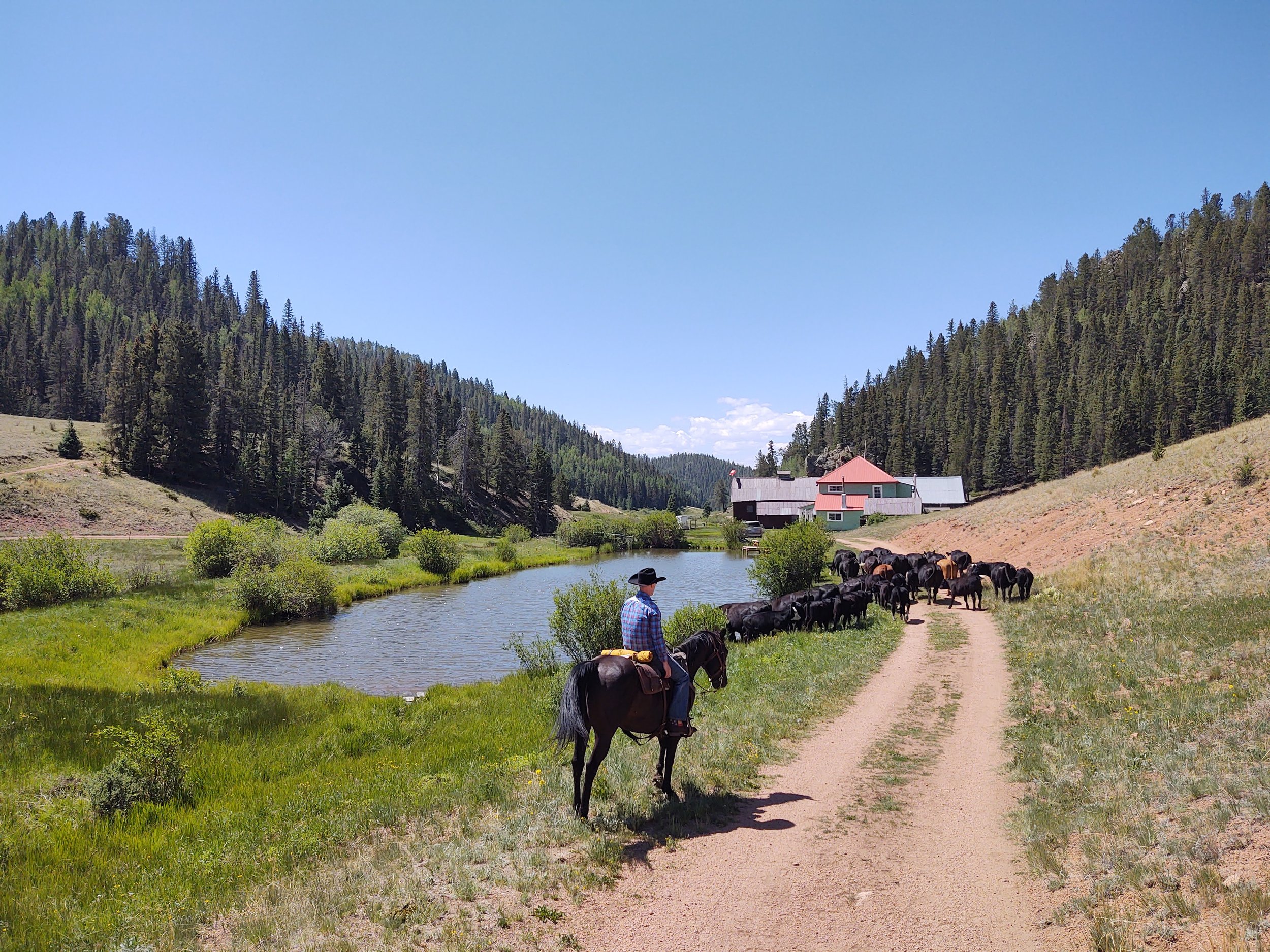
High meadows, aspen benches, alpine basins — 9,000 to 12,000 feet in the central Rockies. Lush forage builds body condition and antler growth. Bulls in bachelor bands; cows and calves in nursery groups. Cool, green, and remote.
Elk reference · Habitat + range
The edge between timber and meadow, worked up and down the mountain with the snow line. Summer high country, winter range, the migration corridors that connect them, and the full list of states that hold elk — led by Colorado, the largest herd on Earth.
The defining feature
Not a metaphor — a literal one. Elk thrive where open foraging ground meets forest cover: a meadow against dark timber, a burn against standing conifer, a grassy park rimmed by aspen. The open ground gives them food; the timber gives them security and shade; the seam between the two is where they spend most of their lives. Find that edge with water nearby and you have found elk.
They work that edge up and down the mountain with the seasons. In summer, high-country meadows at 10,000 feet and above. As snow drives the forage under, they move down to south-facing slopes and valleys that catch winter sun. The vertical migration can be dozens of miles along corridors the herd has used for generations.
Seasonal range
High meadows, aspen benches, alpine basins — 9,000 to 12,000 feet in the central Rockies. Lush forage builds body condition and antler growth. Bulls in bachelor bands; cows and calves in nursery groups. Cool, green, and remote.
Lower south-facing slopes, valleys, and wind-scoured ridges that catch sun and shed snow — 5,000 to 7,500 feet. Coarse browse and pawed-out grass. The limiting season; winter range quality determines how many elk a landscape can actually hold.
Winter range is the bottleneck. A landscape can grow plenty of summer forage and still be capped by how much low-elevation winter ground survives development and deep snow. Protecting winter range is the heart of most elk conservation work.
Range by state
| State | Est. population | Where |
|---|---|---|
| Colorado | ~280,000 | Largest herd on Earth; statewide across the mountains |
| Idaho | ~120,000 | Central wilderness, the panhandle, the Clearwater |
| Montana | ~140,000 | Western two-thirds; the Missouri Breaks and Bitterroots |
| Wyoming | ~110,000 | The Jackson herd, the Bighorns, the Snowy Range |
| Oregon | ~130,000 | Roosevelt on the coast, Rocky Mountain east of the Cascades |
| Utah | ~80,000 | Trophy genetics in the limited-entry units |
| New Mexico | ~70,000 | The Gila, the Valle Vidal, the northern ranges |
| Washington | ~60,000 | Roosevelt west, Rocky Mountain east of the Cascades |
| Arizona | ~35,000 | The Mogollon Rim and the White Mountains |
| Nevada / others | varies | Smaller western herds, expanding in places |
| Eastern US | ~20,000+ | Reintroduced: KY, PA, TN/NC, AR, MI, WI, VA, WV |
Populations are state-agency estimates and vary year to year. Colorado holds the largest elk herd of any state — and any place on Earth — which is the country Elk Glade sits inside.
Frequently asked
Elk live in the edge country between forest and open meadow across western North America — high-country aspen and conifer benches in summer, lower south-facing slopes and valleys in winter. The largest populations are in Colorado, Montana, Idaho, Oregon, Wyoming, Utah, and New Mexico. Reintroduced herds also live in eastern states including Kentucky, Pennsylvania, Tennessee, and Arkansas.
Ideal elk habitat combines open foraging areas (meadows, parks, burns, grasslands) with adjacent forest cover for security and shade, plus reliable water. Elk thrive on the 'edge' where these meet. They use elevation seasonally — high country in summer, lower winter range when snow drives them down — and depend on travel corridors connecting the two.
In the Rocky Mountains, elk summer as high as 10,000–12,000 feet and winter as low as 5,000–7,000 feet, moving with the snow line. At Elk Glade on the south slope of Pikes Peak, the ground ranges from about 8,000 feet at the lower meadow to 9,500 feet on the upper benches — classic summer-to-shoulder-season elk elevation.
The major elk states are Colorado, Montana, Idaho, Oregon, Wyoming, Utah, New Mexico, Washington, and Arizona, plus smaller western herds. Reintroduction has also established huntable or viewable herds in Kentucky, Pennsylvania, Tennessee, North Carolina, Arkansas, Michigan, Wisconsin, Virginia, and West Virginia. Colorado holds the single largest population.
Yes. Many elk herds make seasonal migrations between high-elevation summer range and lower-elevation winter range, sometimes traveling dozens of miles along traditional corridors. Snow depth is the main driver — elk move down when deep snow buries forage and back up as it melts. Some herds are non-migratory where elevation and forage allow year-round residence.
Adult elk are preyed on primarily by wolves and mountain lions; bears (especially grizzlies) and coyotes take calves in spring. Healthy adult elk are formidable and most predation falls on calves, the old, and the weak. In much of elk range, hunting by humans is also a significant source of mortality and a primary management tool.
From the page to the field
Elk Glade guides bull elk on GMU 59 limited entry, on the south slope of Pikes Peak — inside the largest elk population on Earth. Archery, muzzleloader, and four rifle seasons.